There’s no such thing as the perfect suitcase, but there is the right one for the way you travel. Before you look at brands or colours, answer three questions: how many days do your trips usually last? Do you check a bag or travel with hand luggage only? Do you mostly fly with low-cost airlines? Answer those and you’ve already made half the decision.
Carry-on or checked
If your trips last from a weekend to a week, a carry-on suitcase is enough and saves you waiting at the baggage carousel. The standard size is 55 × 40 × 20 cm (about 22 × 14 × 9 in), although each airline sets its own. Always check the dimensions with wheels and handles included: many “carry-on” suitcases are a couple of centimetres too big.
For longer trips, or if you’re packing warm clothes, you’ll need to check a bag. A medium suitcase (around 65 cm) is usually enough for a week; a large one (70–75 cm) is for two weeks or for two people sharing one suitcase.
Tip: before you buy, check the exact cabin bag dimensions on the website of the airline you fly with most. A suitcase just 2 cm too big can mean having to check it at the gate.
Hard or soft
- Hard (polycarbonate or polypropylene): protects your things better, stands up to rain and is easy to clean. Polycarbonate takes knocks best without breaking; cheap ABS tends to crack.
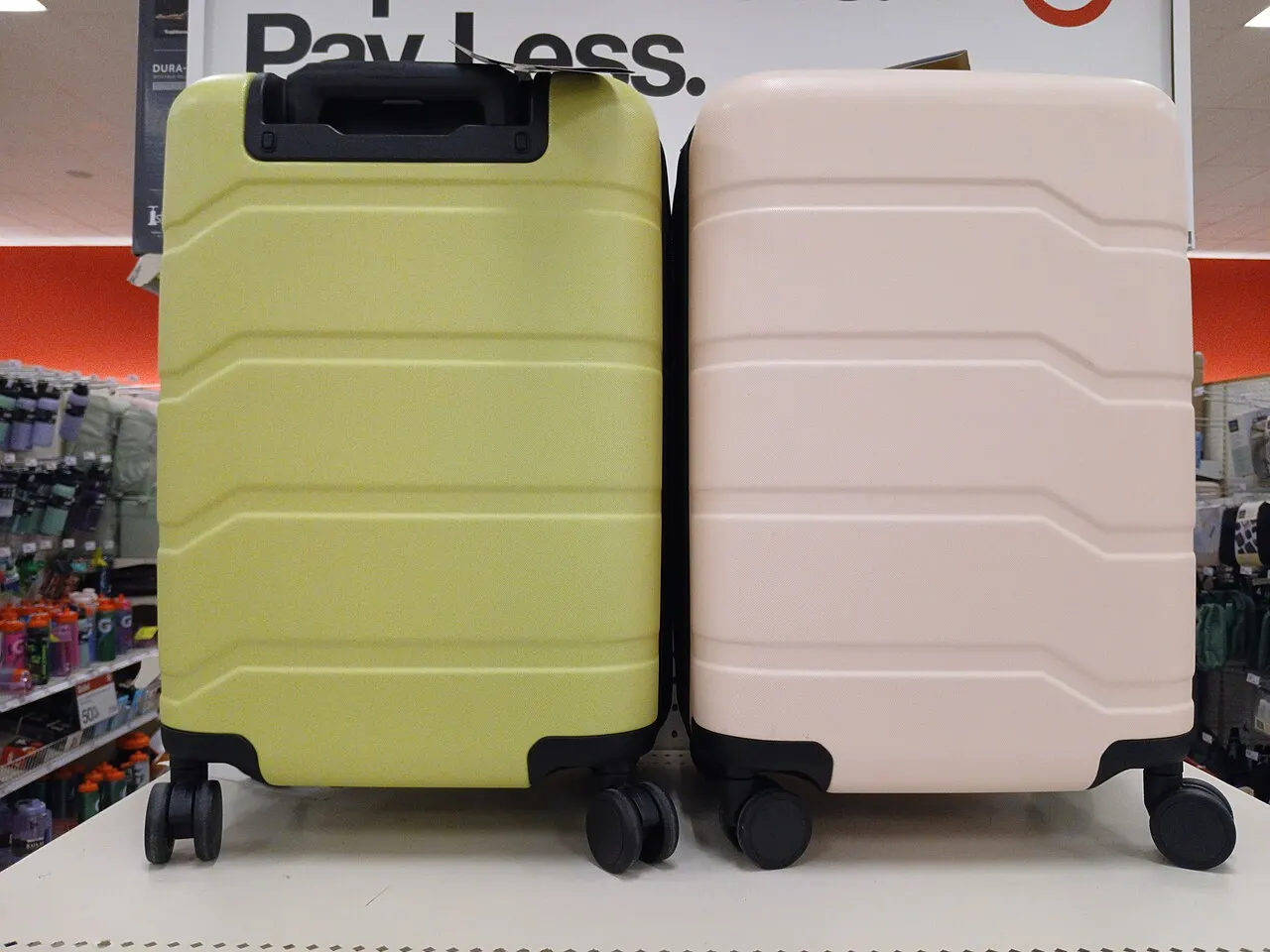
- Soft (nylon or polyester): weighs less, gives a little when you’re short of space and usually has very practical outside pockets.
If you check bags often, a hard suitcase is worth it. If you travel carry-on and want to use every centimetre, a soft one is more flexible.
Wheels, handle and zip: where suitcases break
Suitcases rarely fail because of the shell: they fail at the wheels, the telescopic handle or the zip. Look out for:
- Four double wheels that turn 360°: the suitcase rolls beside you without putting weight on your wrist. Two large wheels cope better with cobblestones and bumpy pavements.
- A telescopic handle with no wobble and several height settings.
- A thick zip, ideally from a well-known maker, with a double pull.
Weight, the forgotten factor
Every kilo of empty suitcase is a kilo less of luggage. In the cabin, where many airlines allow 7–10 kg, a 2.5 kg suitcase versus a 4 kg one makes a real difference. For checked bags, the limit is usually 23 kg in economy: always weigh your suitcase before leaving home.
A lock: yes, but TSA
If you’re travelling to the United States, security officers may open checked bags. A lock with the TSA system lets them do it with their key without breaking it; an ordinary one will end up cut off. Outside the US it works just as well, and it puts off the curious.
Important: the weight of the empty suitcase counts towards the limit. Look for cabin models under 2.5 kg and checked models under 4 kg.
In short
For most travellers, the best combination is a lightweight hard-shell carry-on with four wheels and, if you travel for more than a week, a medium polycarbonate suitcase to check in. Spend your money on quality wheels and zips, not on the logo.
As an Amazon Associate we earn from qualifying purchases.